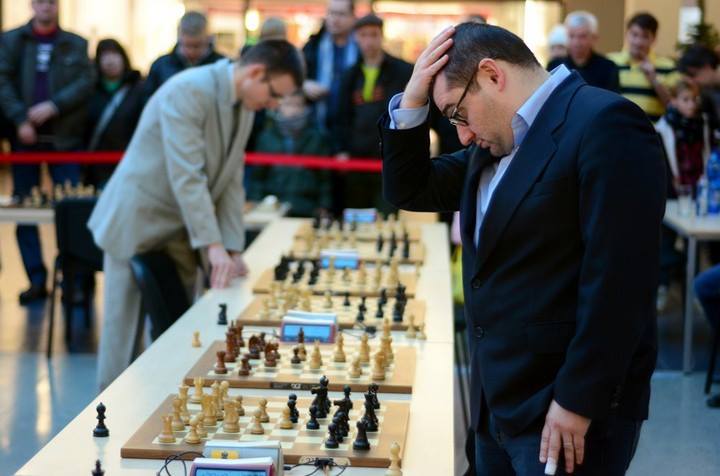
Chess is a board game for two players.[1] It is played in a squareboard, made of 64 smaller squares, with eight squares on each side. Each player starts with sixteen pieces: eight pawns, two knights, two bishops, two rooks, one queen and one king.[2] The goal of the game is for each player to try and checkmate the king of the opponent. Checkmate is a threat (‘check’) to the opposing king which no move can stop. It ends the game.[3][4]
During the game the two opponents take turns to move one of their pieces to a different square of the board. One player (‘White’) has pieces of a light color; the other player (‘Black’) has pieces of a dark color. There are rules about how pieces move, and about taking the opponent’s pieces off the board. The player with white pieces always makes the first move.[4] Because of this, White has a small advantage, and wins more often than Black in tournament games.[5][6]
Chess is popular and is often played in competitions called chess tournaments. It is enjoyed in many countries, and is a national hobby in Russia.[7]
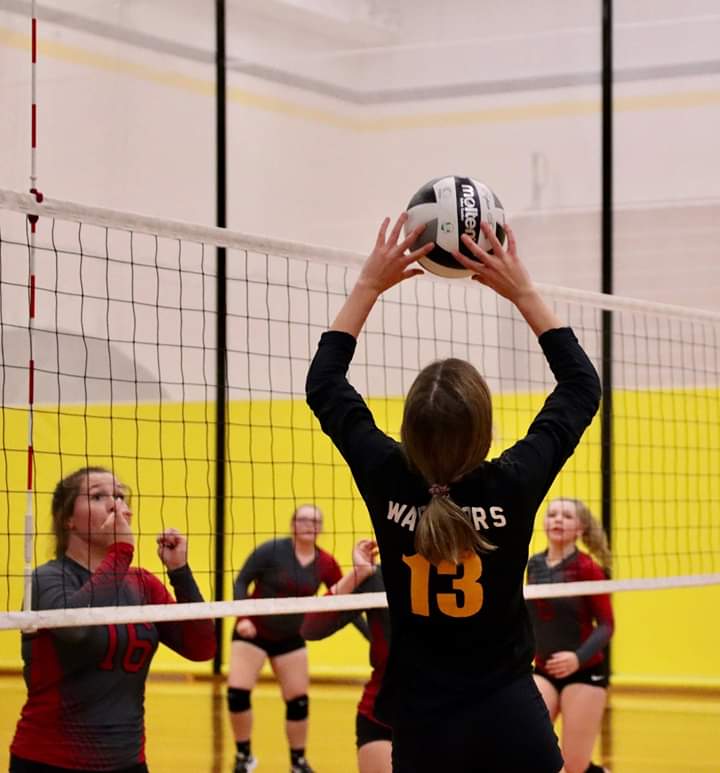
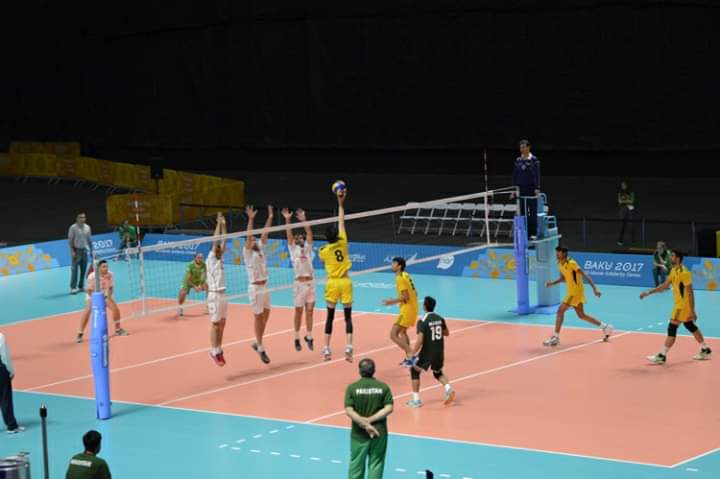
Volleyball is a team sport. The teams are separated by a large net. It has six players on each side of the net. Each team is allowed twelve substitution players. The game starts when the captain from each team decides which side of the court they will play on, by the toss of a coin, which also determines who will serve (hit) the ball first. The point of the game is to keep the ball in the air. The ball can be played with any part of the body, with a maximum of three strokes a team. If at any point the ball hits the floor, the side that the ball landed on it is a point for the other team.
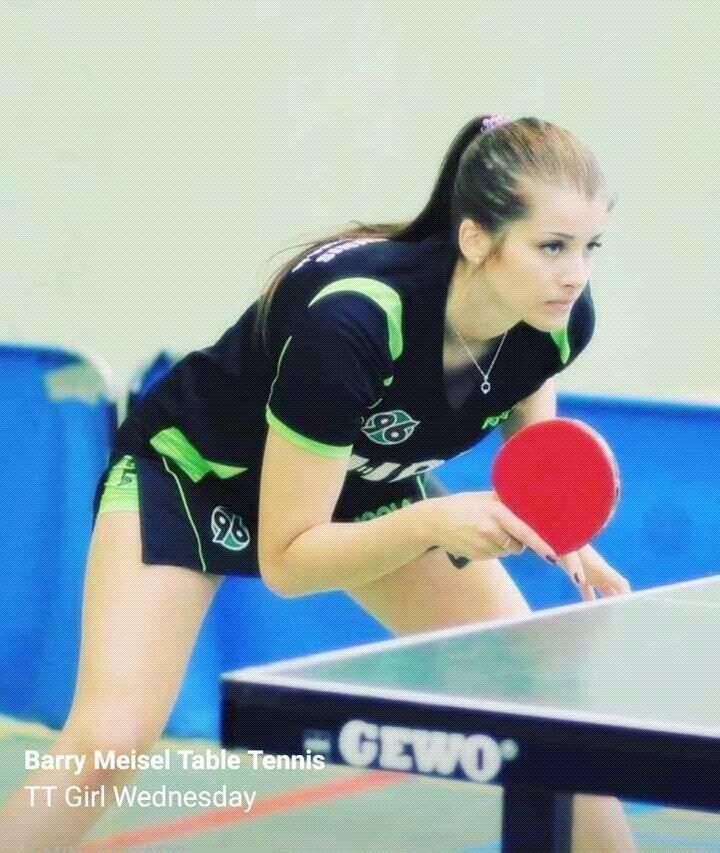
Table tennis, also known as ping-pong, is a sport in which two or four players hit a lightweight ball back and forth across a table using small rackets. The game takes place on a hard table divided by a net. Except for the initial serve, the rules are generally as follows: players must allow a ball played toward them to bounce one time on their side of the table, and must return it so that it bounces on the opposite side at least once. A point is scored when a player fails to return the ball within the rules. Play is fast and demands quick reactions. Spinning the ball alters its trajectory and limits an opponent’s options, giving the hitter a great advantage.
Volleyball is a team game which has six players that play on either side of the net. A set of rules decide the score that each team is able to make against the other team. The game begins with a player from one team throwing the ball using hand or arm over the net so that the opposite team can receive it on their court.
The basic rule is to prevent the received ball from hitting the ground so that it can be thrown back to the other team with up to 3 touches from the team. A foul happens if one person from the team touches the ball more than twice (double-hit) while it’s on their side of the net. Also, a team scores a point by throwing the call across the net to the other team’s side such that it hits the ground directly or the player fails to send it back over the net.
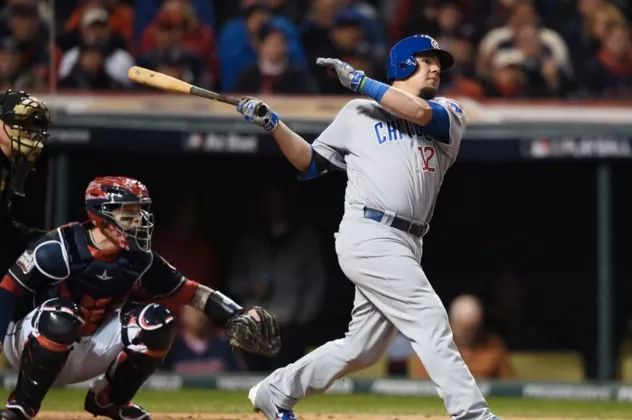
It is a game played everywhere, in parks, playgrounds, and prison yards, in back alleys and farmers fields, by small children and old men, raw amateurs and millionaire professionals. It is a leisurely game that demands blinding speed. It is the only game in which the defence has the ball. It follows the seasons beginning each year with the expectancy of spring time, and ending with the hard facts of autumn. Americans have played baseball for more then 200 years, while they conquered a continent, fought at war with one another, struggled over labour and civil rights, and the meaning of freedom. Baseball is a deeply conservative game that manages to be years ahead of it’s time. It is an American odyssey that links sons and daughters to fathers and grandfathers. It also reflects age old American tensions between workers and owners, scandal and reform, the individual and the collective. It is a game in which every player is measured against all of those who have gone before them. “But most of all baseball is about time and timelessness, speed and grace, failure and success, and in the end coming home.
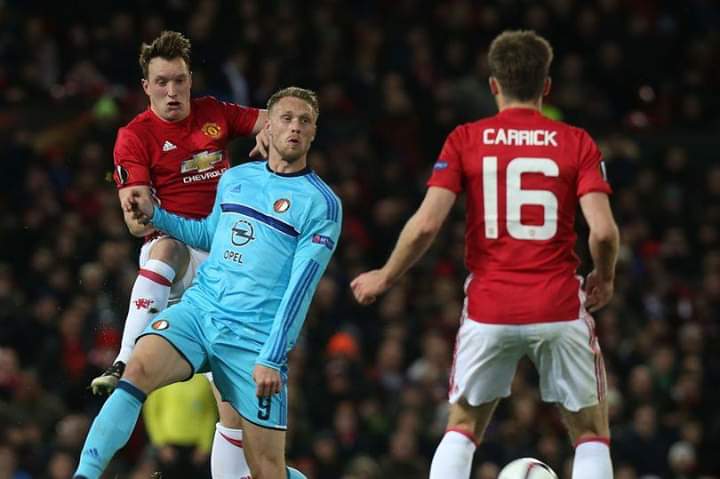
Soccer is a popular sport played all over the world. Even though it has only been popular in the United States for the past 30 years, soccer has been a long time favorite most everywhere else. The sport dates back to the Egyptians, who played games involving the kicking of a ball. Now, the sport has grown to a global pastime, including men’s and women’s teams, and the World Cup (which is played every four years).
Soccer originated with kicking games played by people in ancient civilizations. The modern version came about in the early nineteenth century, in England. It started as a game involving kicking and handing, but later this branched off into two separate sports: rugby and football (which is what the English call soccer). Around…show more content… In addition to the field itself, all that is needed for a game is two goals (eight feet high and eight yards apart) and a ball. Each player wears hard plastic or padded shingaurd, covered by long socks, for protection during play. Cleats are also worn for traction on the field. A goalie may also wear a special padded shirt, and gloves to protect his or her hands. A standard field, as regulated by the Federation Internationale de Football Association (or FIFA), has a length between 100 and 130 yards, and a width of between 50 and 100 yards. The rules of play for soccer have deliberately been kept simple. The referee makes most of the decisions, and attempts to encourage fair play. The game starts off with a kick off, and the teams are allowed to pass, dribble, juggle, head, kick, and shoot the ball to place it down the field, and (hopefully, or eventually) into their opponent’s goal. If the ball is kicked off the field over the length of the field, the other team is given a throw-in, where the ball is thrown over the player’s head, and back onto the field. If the ball is kicked over the goal, or across the width of the field, either a corner kick results (by the offensive team, where the ball is placed on the corner of the field and kicked into play) or the defensive team is awarded a goal kick, where the ball is placed on the corner of the goal box, and kicked back into play. If a goal is scored, the ball is taken back to the center ofShow MoreRelated
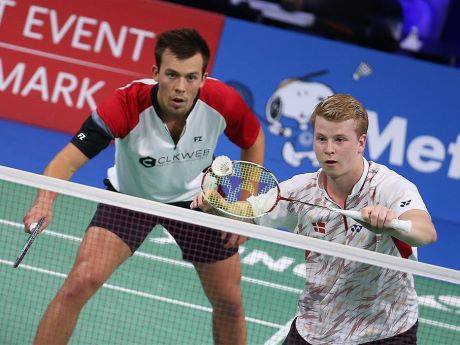
Laws of Badminton The Laws of Badminton COURT AND COURT EQUIPMENT 1. The court shall be a rectangle marked out with lines 40 mm wide as shown in Diagram A. 1.2. The lines marking out the court shall be easily distinguishable and preferably be coloured white or yellow. 1.3. All the lines shall form part of the area which they define. 1.4. The posts shall be 1.55 metres in height from the surface of the court and shall remain vertical when the net is strained as provided in Law 1.10. 1.5. The posts shall be placed on the doubles side lines as in Diagram A irrespective of whether singles or doubles is being played. The posts or its supports shall not extend into the court beyond the side lines. 1.6. The net shall be made of fine cord of dark colour and even thickness with a mesh of not less than l5 mm and not more than 20 mm. 1.7. The net shall be 760 mm in depth and at least 6.1 metres wide. 1.8. The top of the net shall be edged with a 75 mm white tape doubled over a cord or cable running through the tape. This tape shall rest upon the cord or cable. 1.9. The cord or cable shall be stretched firmly, flush with the top of the posts. 1.10. The top of the net from the surface of the court shall be 1.524 metres at the centre of the court and 1.55 metres over the side lines for doubles. 1.11 There shall be no gaps between the ends of the net and the posts. If necessary, the full depth of the net at the ends shall be tied to the posts. img DIAGRAM A Note: (1) Diagonal length of full court = 14.723m (2) Court as shown above can be used for both singles and doubles play (3) ** Optional testing marks as shown in Diagram B. SHUTTLE 2.1 The shuttle shall be made of natural and / or synthetic materials. From whatever material the shuttle is made, the flight characteristics generally shall be similar to those produced by a natural feathered shuttle with a cork base covered by a thin layer of leather. 2.2 Feathered Shuttle 2.2.1 The shuttle shall have 16 feathers fixed in the base. 2.2.2 The feathers shall have a uniform length between 62 mm to 70 mm when measured from the tip to the top of the base. 2.2.3 The tips of the feathers shall lie on a circle with a diameter from 58 mm to 68 mm. 2.2.4 The feathers shall be fastened firmly with thread or other suitable material. 2.2.5 The base shall be 25 mm to 28 mm in diameter and rounded on the bottom. 2.2.6 The shuttle shall weigh from 4.74 to 5.50 grams. 2.3 Non-Feathered Shuttle 2.3.1 The skirt, or simulation of feathers in synthetic materials, shall replace natural feathers. 2.3.2 The base shall be as described in Law 2.2.5. 2.3.3 Measurements and weight shall be as in Laws 2.2.2, 2.2.3 and 2.2.6. However, because of the difference in the specific gravity and other properties of synthetic materials in comparison with feathers, a variation of up to 10 per cent shall be acceptable. 2.4 Subject to there being no variation in the general design, speed and flight of the shuttle, modifications in the above specifications may be made with the approval of the Member Association concerned, in places where atmospheric conditions due to either altitude or climate make the standard shuttle unsuitable. TESTING A SHUTTLE FOR SPEED 3.1 To test a shuttle, a player shall use a full underhand stroke which makes contact with the shuttle over the back boundary line. The shuttle shall be hit at an upward angle and in a direction parallel to the side lines. 3.2 A shuttle of correct speed will land not less than 530 mm and not more than 990 mm short of the other back boundary line as in Diagram B. img DIAGRAM B RACKET 4.1 The racket shall be a frame not exceeding 680 mm in overall length and 230 mm in overall width consisting of the main parts described in Laws 4.1.1 to 4.1.5 as illustrated in Diagram C. 4.1.1 The handle is the part of the racket intended to be gripped by a player. 4.1.2 The stringed area is the part of the racket with which it is intended that a player hits the shuttle. 4.1.3 The head bounds the stringed area. 4.1.4 The shaft connects the handle to the head (subject to Law 4.1.5). 4.1.5 The throat (if present) connects the shaft to the head. img DIAGRAM C 4.2 The stringed area: 4.2.1 shall be flat and consist of a pattern of crossed strings either alternately interlaced or bonded where they cross. The stringing pattern shall be generally uniform and, in particular, not less dense in the centre than in any other area; and 4.2.2 shall not exceed 280 mm in overall length and 220 mm in overall width. However, the strings may extend into an area which otherwise would be the throat, provided that: 4.2.2.1 the width of the extended stringed area does not exceed 35 mm; and 4.2.2.2 the overall length of the stringed area does not then exceed 330 mm. 4.3 The racket: 4.3.1 shall be free of attached objects and protrusions, other than those used solely and specifically to limit or prevent wear and tear, or vibration, or to distribute weight, or to secure the handle by cord to the play.
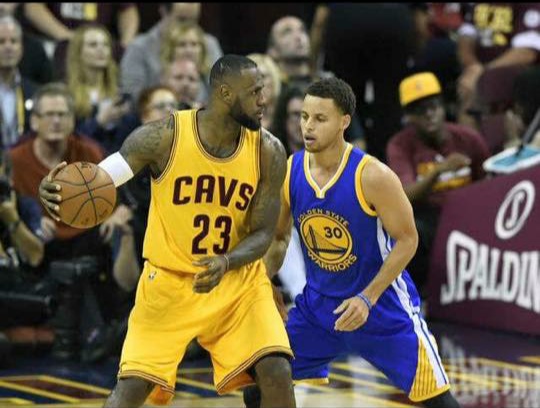
Wardell Stephen “Steph” Curry II (born March 14, 1988)[1] is an American professional basketball player who plays for the Golden State Warriors of the National Basketball Association (NBA). Listed at 6 ft 3 in (1.91 m) tall and weighing 190 lb (86 kg),[2] Curry plays the point guard position and is considered by some to be the greatest shooter in NBA history.[3][4][5] The 2015 NBA Most Valuable Player and a two-time NBA All-Star, he is the son of former NBA player Dell Curry. [ 3438 more words. ]


 Sportsweb